
A new trend in cybercrime has emerged, targeting users seeking customer support for major brands such as Apple, Bank of America, Netflix, Microsoft, PayPal, Facebook, and HP.
Recent research from Malwarebytes Senior Director of Research, Jérôme Segura, has uncovered a wave of fraud attempts where cybercriminals are exploiting online search engines particularly through sponsored Google ads to mislead users and hijack their search experience.
Sophisticated Search Parameter
The attack begins when a user searches for 24/7 customer support for a leading brand and clicks on a sponsored result that appears entirely legitimate.
However, upon clicking the ad, users are redirected to the official support section of the genuine brand website.
The deception lies in the manipulation of the website’s search parameters: scammers embed their own fraudulent support number into the search results displayed on the legitimate site.
The URL in the browser remains the true address of the brand, lulling users into a false sense of security, while the phone number shown is in fact maintained by the attackers.
By exploiting vulnerabilities in how search query parameters are processed and reflected by these sites, the attackers perform what security experts term a search parameter injection attack.
Brands like Netflix, whose search functionality displays user-supplied input without proper validation or sanitization, prove particularly susceptible.
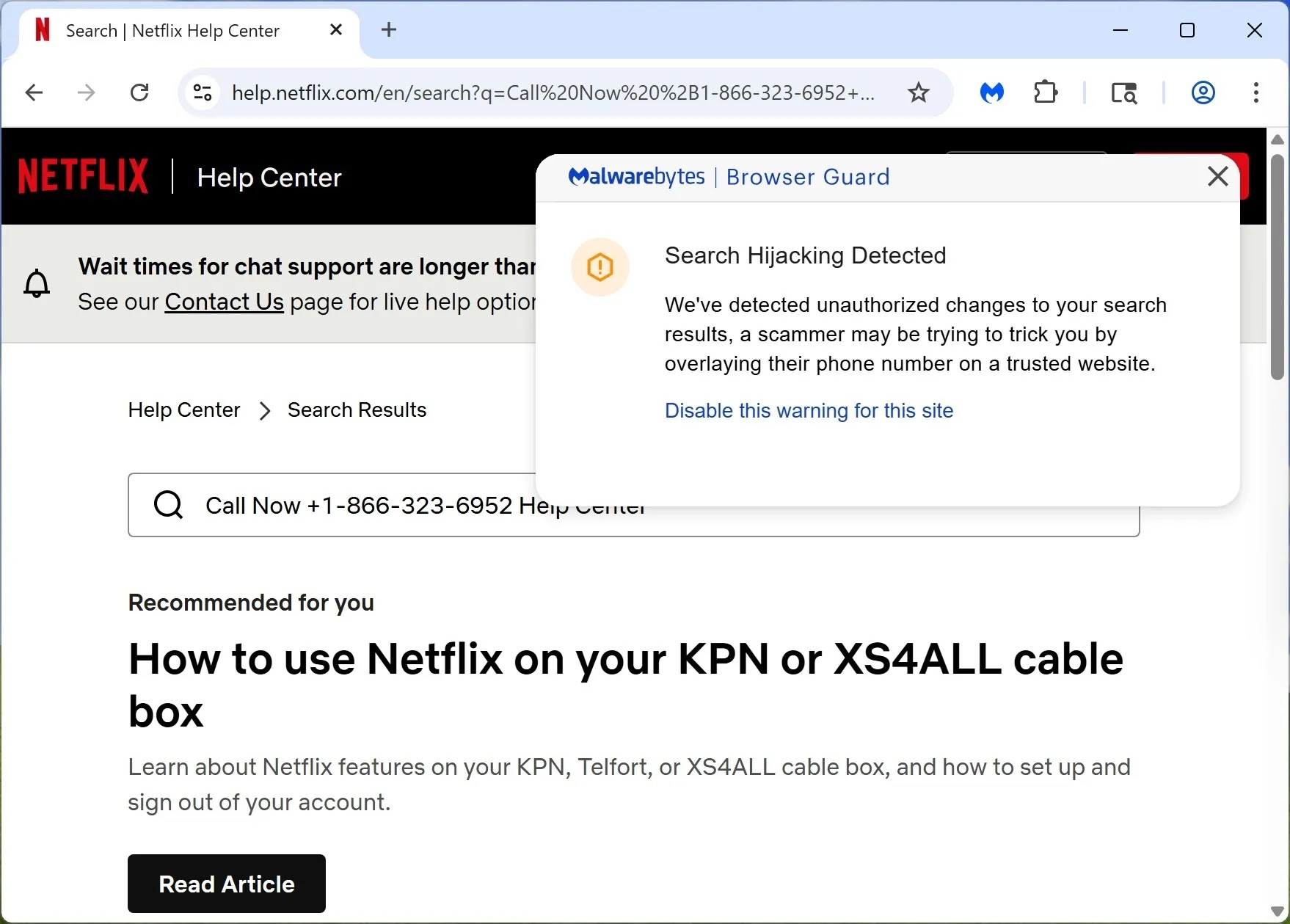
For example, users visiting Netflix’s help center via a poisoned link would observe an authentic page layout and URL, but an injected fake phone number appears as a prominent search result. This subtle technique makes the scam exceedingly convincing.
If a victim calls the number, they are greeted by fraudsters impersonating legitimate brand representatives who may request sensitive personal information, payment card details, or even remote access to the user’s computer.
In cases involving financial institutions such as Bank of America or PayPal, the potential consequences escalate, with attackers aiming to compromise the victim’s financial accounts.
Detection and Prevention Efforts
Fortunately, solutions like Malwarebytes Browser Guard can detect such search hijacking attempts, warning users when unauthorized modifications are made to search results such as the overlay of a fake phone number.
Nevertheless, the effectiveness and sophistication of these attacks highlight a critical need for better web security practices.
According to the Report, Major brands must reevaluate how their websites handle and display user-generated search inputs to eliminate reflected input vulnerabilities.
Notably, the manipulation varies in subtlety across different brands. The HP support site, for instance, displays “4 Results for” before scammers’ inserted text, which can trigger user suspicion.
In other cases, such as Apple’s support page, the scam is even more insidious: the site claims no matches for the visitor’s search, effectively encouraging them to call the only number visible the attacker’s.
This method of embedding fake information into genuine web pages via poisoned search parameters is a fast-evolving threat.
As cybercriminals increasingly leverage search engine advertising to reach their targets, both companies and consumers must remain vigilant.
Brands should promptly patch input reflection vulnerabilities, and users should verify support contacts through official sources never relying solely on search engine results or unfamiliar phone numbers, no matter how legitimate the site may appear.
Find this Story Interesting! Follow us on LinkedIn and X to Get More Instant updates

