
The threat actor group APT-C-36, also known as Blind Eagle, has been orchestrating sophisticated cyber-attacks against government agencies, financial institutions, and critical infrastructure, with a pronounced focus on Colombia and the wider Latin American region.
Recent intelligence reveals that Blind Eagle continues to refine its attack methodologies, leveraging advanced phishing campaigns and exploiting vulnerabilities to infiltrate high-value targets.
Technical Overview of Recent Campaigns
Blind Eagle’s operations typically initiate with targeted phishing emails, which are crafted to deliver malicious URLs to recipients within government and financial sectors.
In late 2024 and early 2025, these campaigns exploited the CVE-2024-43451 vulnerability in Microsoft Windows a flaw that previously enabled attackers to harvest NTLMv2 password hashes with minimal user interaction.
Despite Microsoft’s patch release in November 2024, Blind Eagle rapidly adapted its tactics, shifting from credential harvesting to direct malware delivery via malicious URLs embedded in phishing emails.
Upon user interaction, these URLs prompt the download of a malicious file. Execution of this file triggers a WebDAV request over HTTP port 80, using the user agent string ‘Microsoft-WebDAV-MiniRedir/10.0.19044’ or ‘10.0.19045’.
WebDAV, a protocol designed for file transmission over the internet, is exploited by the attackers to download secondary payloads and execute malware on the victim’s device.
Attackers receive notifications when files are accessed, enabling real-time tracking of compromised targets.
Incident Detection
In February 2025, Darktrace detected activity consistent with Blind Eagle’s tactics on a Colombian organization’s network.
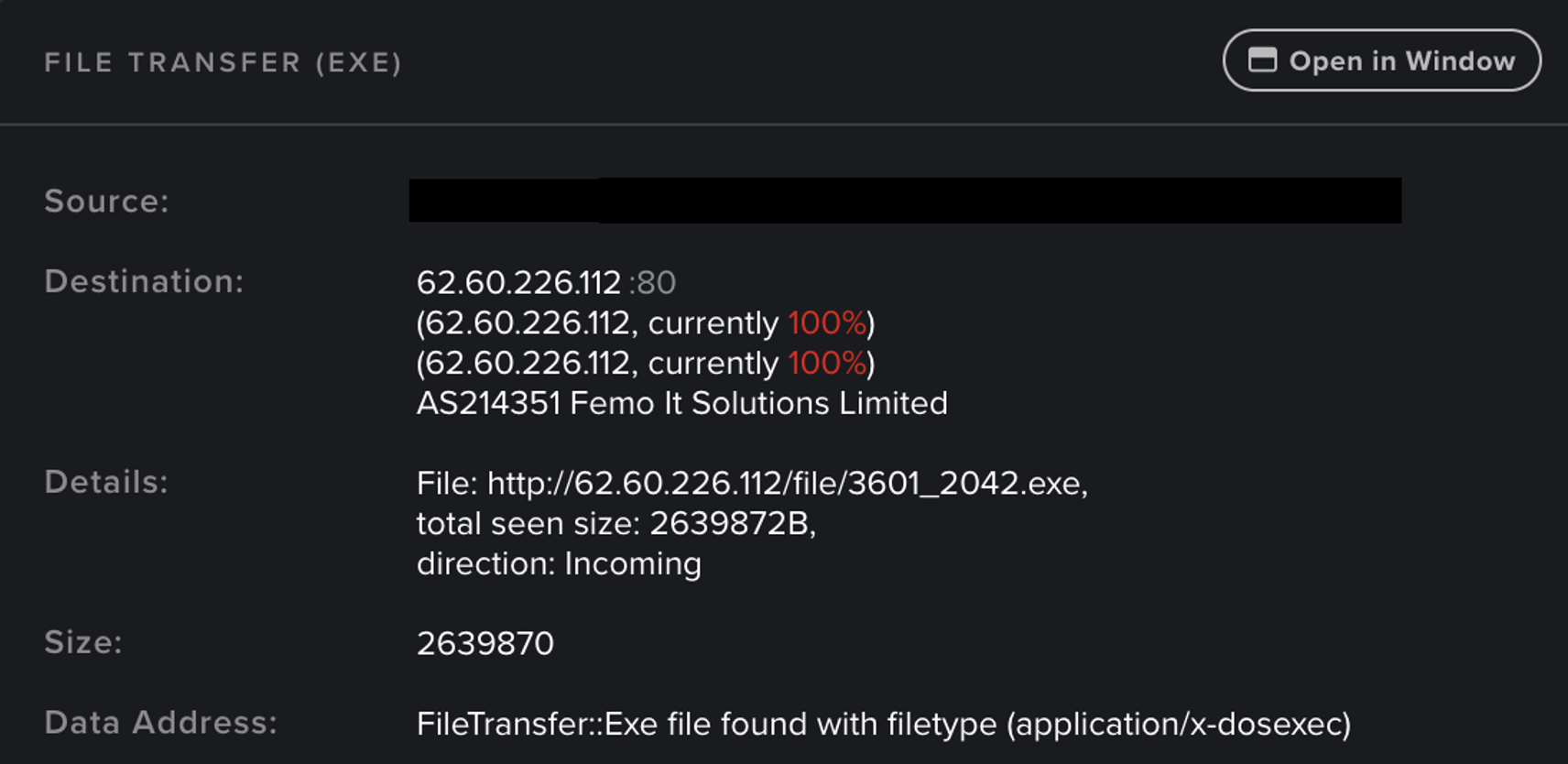
Within five hours, a compromised device connected to a rare external IP address (62[.]60[.]226[.]112, geolocated in Germany), downloaded multiple executable files, and initiated data exfiltration.
Open-source intelligence later linked this IP to known phishing and malware campaigns.
The infected device proceeded to interact with a dynamic DNS endpoint (21ene.ip-ddns[.]com), a technique that allows attackers to maintain persistent command-and-control (C2) communications by circumventing static IP restrictions.
This endpoint has been previously associated with Remcos RAT, a remote access trojan frequently deployed in phishing campaigns attributed to Blind Eagle.
Further investigation revealed that the compromised device also connected to diciembrenotasenclub[.]longmusic[.]com over TCP port 1512, and uploaded significant volumes of data (60 MiB and 5.6 MiB, respectively) to both dynamic DNS and malicious host endpoints.
These actions triggered multiple high-priority alerts in Darktrace’s anomaly-based monitoring systems, indicating a full attack lifecycle from initial compromise to data exfiltration.

Blind Eagle’s persistence and rapid adaptation to patched vulnerabilities underscore the limitations of relying solely on traditional patch management.
The group’s ability to repurpose established tactics, techniques, and procedures (TTPs) highlights the necessity for organizations to deploy advanced, anomaly-based detection systems capable of identifying behavioral deviations and autonomously containing threats in real time.
The incident further illustrates the importance of enabling automated response capabilities within security solutions. In this case, the absence of such measures allowed the attack to escalate until manual intervention by the security team.
Indicators of Compromise (IoCs)
| IoC | Type | Confidence |
|---|---|---|
| Microsoft-WebDAV-MiniRedir/10.0.19045 | User Agent | Medium |
| 62[.]60[.]226[.]112 | IP Address | Medium |
| hxxp://62[.]60[.]226[.]112/file/3601_2042.exe | Payload Download | Medium |
| 21ene.ip-ddns[.]com | Dynamic DNS Endpoint | Medium |
| diciembrenotasenclub[.]longmusic[.]com | Hostname | Medium |
Find this Story Interesting! Follow us on LinkedIn and X to Get More Instant updates

