
A new wave of advanced persistent threat (APT) attacks has been attributed to the North Korea-linked Kimsuky group, which is now leveraging generative AI tools like ChatGPT to enhance spear-phishing campaigns.
According to the Genians Security Center (GSC), the campaign uncovered on July 17, 2025, exploited deepfake images of South Korean military employee ID cards to infiltrate defense-related entities.
The attack underscores a growing trend where state-sponsored actors use artificial intelligence for social engineering, identity forgery, and malware delivery while employing obfuscation tactics to evade conventional detection technologies.
Generative AI and Deepfake ID Card Exploits
Investigators revealed that the attackers used ChatGPT to generate convincing deepfake military ID card samples, which were sent to victims under the guise of official government-issued drafts.
The phishing emails mimicked domains of South Korean defense institutions and carried compressed files named “Government_ID_Draft.zip.”
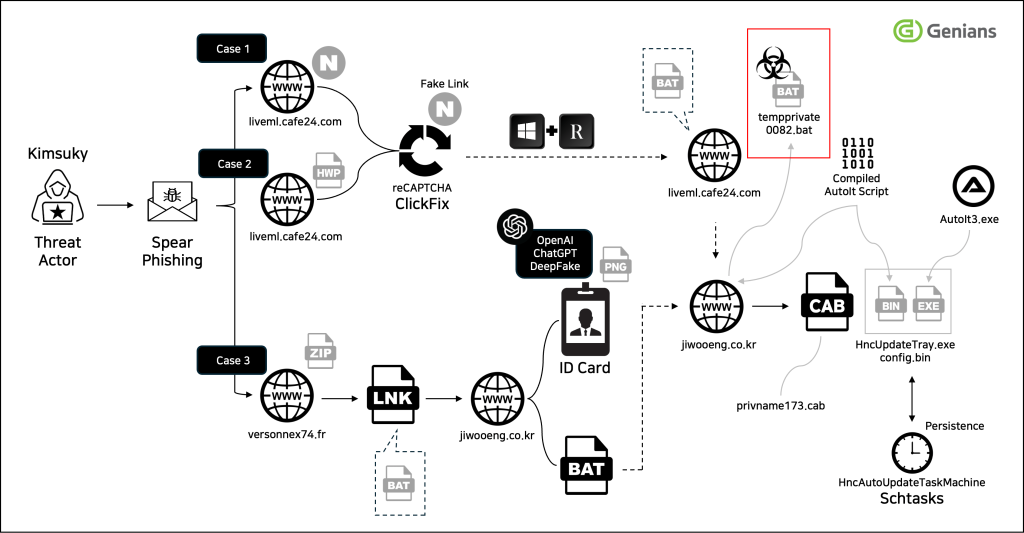
Inside, malicious LNK shortcut files launched obfuscated commands via cmd.exe, dynamically reconstructing PowerShell scripts from encoded environment variables. These decoded commands connected to a command-and-control (C2) server hosted on jiwooeng.co[.]kr.
The compromised systems subsequently downloaded a deepfake PNG image file along with a malicious batch file. Metadata confirmed that the ID images were AI-generated, and verification using the TruthScan Deepfake-Detector service flagged them with a 98% likelihood of being forged.
Analysts concluded that ChatGPT had been manipulated with tailored prompts to produce the counterfeit documents, bypassing restrictions designed to block ID replication.
Once executed, the batch scripts delay detection using a timed 7-second execution hold before retrieving payloads from remote servers. These payloads included an executable disguised as a legitimate “HncUpdateTray.exe” Hancom Office updater, which was in fact AutoIt-based malware.
The compiled AutoIt script (“config.bin”) communicated with the C2 server, used advanced Vigenère-like cipher obfuscation, and deployed additional batch scripts enabling data theft and remote control of infected devices.
Evading Detection and the Need for EDR
The campaign borrowed earlier “ClickFix” tactics previously linked to Kimsuky, where phishing lures impersonated South Korean portal company security alerts. These attacks relied on malicious CAB archives delivered through compromised domains (liveml.cafe24[.]com, snuopel.cafe24[.]com).
Whether by AutoIt scripts, Python loaders hidden with comment camouflage, or deepfake decoys, the overarching tactic remained consistent: hide execution flows from antivirus engines through obfuscation, staged downloads, and masquerading as standard software processes.
Researchers stressed that traditional antivirus solutions were ineffective against heavily obfuscated batch commands and AI-generated social engineering content.
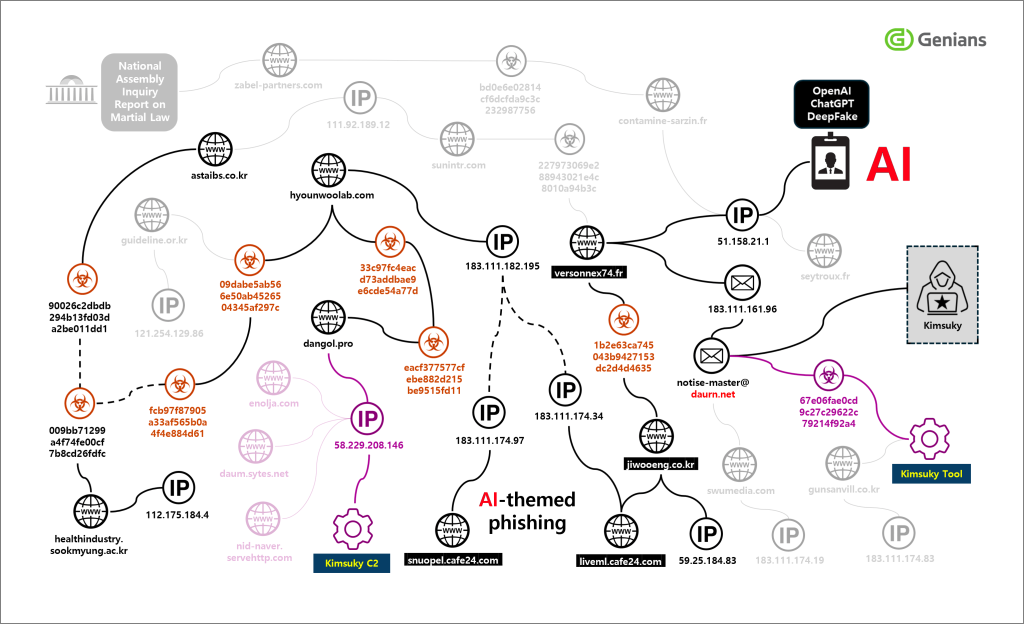
Instead, endpoint detection and response (EDR) solutions were highlighted as essential for identifying malicious .lnk shortcuts, tracing hidden PowerShell and AutoIt execution chains, and correlating activity across infrastructure.
Genians reported that its EDR successfully detected these staged intrusions, illustrating how behavior-based monitoring can neutralize Kimsuky’s AI-powered deception.
The case highlights a pivotal moment in cyber operations: AI-aided forgery coupled with persistent obfuscation is redefining phishing campaigns.
Without proactive EDR monitoring, organizations risk falling prey to generative AI–enabled APT strategies capable of breaching even high-security government domains.
IoC (Indicator of Compromise)
MD5
09dabe5ab566e50ab4526504345af297
33c97fc4eacd73addbae9e6cde54a77d
143d845b6bae947998c3c8d3eb62c3af
8684e5935d9ce47df2da77af7b9d93fb
90026c2dbdb294b13fd03da2be011dd1
Find this Story Interesting! Follow us on Google News , LinkedIn and X to Get More Instant Updates

 attacks has been attributed to the North Korea-linked Kimsuky group.)