
Threat actors are increasingly abusing a stealthy Active Directory technique known as DCSync to impersonate domain controllers and extract password hashes from enterprise networks.
Documented by Trellix, DCSync differs from noisy attacks that exploit a vulnerable server or deploy visible malware; it abuses the normal replication process Windows domain controllers use to synchronize directory data across an organization.
In a typical Active Directory environment, multiple domain controllers maintain identical copies of user accounts, groups, authentication information, and other directory objects.
Hackers Impersonate Domain Controllers
When an employee changes a password, domain controllers replicate that update so the new credentials work throughout the organization.
This trusted replication mechanism is essential for large distributed networks, but it can also become a powerful attack path when an intruder gains privileged access.
A DCSync attack begins after an attacker compromises an account with domain replication permissions, often a Domain Admin account or another highly privileged identity.
Rather than attacking the domain controller directly, the adversary sends a replication request that makes their system appear to be an authorized domain controller needing directory updates.
If the request is accepted, the attacker can obtain password hash data for Active Directory accounts, including highly valuable identities such as the KRBTGT account.
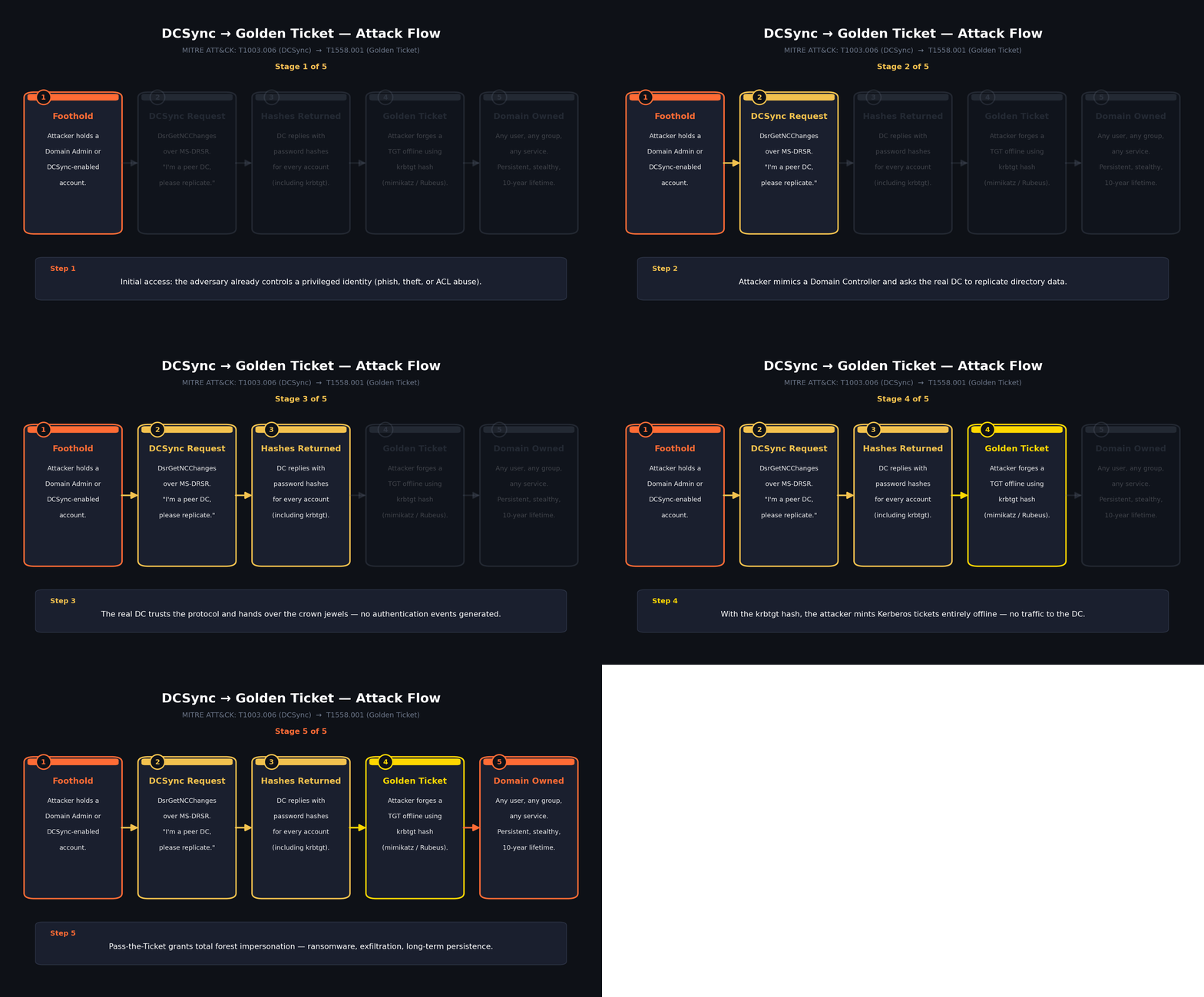
These hashes are not plaintext passwords, but they can be cracked offline, used in pass-the-hash attacks, or leveraged to establish deeper, more persistent access to the domain.
The most serious consequence is the potential creation of a Golden Ticket. By obtaining the KRBTGT account hash, attackers can forge Kerberos Ticket Granting Tickets that appear to be legitimate.
A forged ticket can grant the attacker elevated permissions and enable access to systems, services, files, and sensitive enterprise data without repeatedly authenticating through normal channels.
Trellix stated that this makes DCSync particularly dangerous for ransomware groups, espionage operations, and financially motivated intrusions.
An attacker with replication-level access could read executive communications, access human resources data, deploy malicious payloads across endpoints, disable security controls, or maintain long-term persistence.
Even after defenders reset a compromised user account, a Golden Ticket may continue to provide access until they rotate the KRBTGT password correctly.
Traditional endpoint defenses may struggle to identify DCSync because attackers can use legitimate administrative functions or modify common offensive tools to avoid signature-based detection.
Security teams should therefore focus on the request’s behavior rather than the name or fingerprint of the tool generating it.
Network Detection and Response platforms can help identify anomalous directory replication traffic by determining whether a request originated from a legitimate domain controller.
Treat a replication attempt from a workstation, a marketing laptop, an application server, or an unfamiliar host as a high-priority event. Monitoring privileged account use, auditing replication permissions, and restricting Domain Admin access can further reduce exposure.
Active Directory remains the identity backbone of many organizations. When attackers successfully impersonate a domain controller, they aren’t simply stealing credentials; theyare trying to seize control of the entire authentication environment.
Detect 58% more threats with fresh intelligence from 16K+ organizations. Integrate TI Feeds in you SOC

