
A new research report highlights the growing trend of Hacktivist Proxy Operations, a modern form of cyber disruption that blends activism, propaganda, and state-aligned pressure without formal government control.
Unlike conventional state-sponsored cyber operations or financially motivated cybercrime, these activities are carried out by non-state groups whose actions align with state geopolitical interests, allowing governments to maintain plausible deniability.
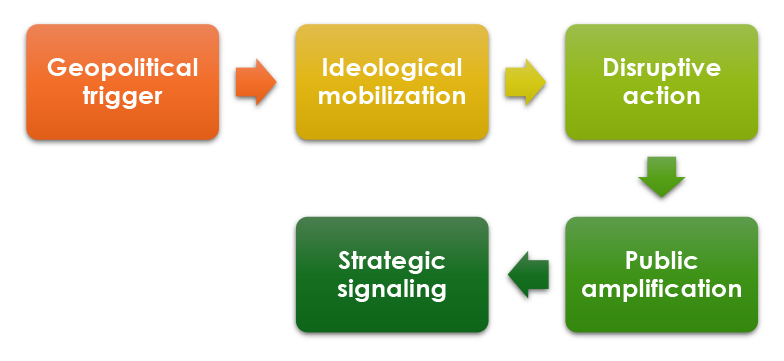
Hacktivist proxy campaigns typically follow a predictable pattern of activation driven by global political events, such as sanctions, arms-supply announcements, or diplomatic disputes.
These events trigger ideological mobilization within hacktivist networks, prompting waves of distributed denial-of-service (DDoS) attacks, website defacements, and symbolic intrusions against strategic targets like government portals, banks, transportation platforms, and media outlets.
While the attacks themselves are often technically simple, their psychological and political impact can be significant.
Quick disruption of high-visibility targets during tense geopolitical moments amplifies perceptions of instability and punishes adversary nations without requiring advanced infrastructure or covert command structures.
Strategic Utility and Operational Model
Researchers describe Hacktivist Proxy Operations as a repeatable and low-cost operational model. The process starts with a geopolitical trigger, followed by narrative mobilization, in which hacktivist channels call for digital retaliation.
Volunteers then coordinate targets using open communication platforms and launch disruptive attacks using standard tools.
Public claims of success, often exaggerated, are rapidly circulated online, magnifying both the impact and confusion. Once the signalling goals are met, operations usually de-escalate, preserving deniability and readiness for future activation.
These campaigns create defensive cost asymmetry; they are cheap to mount but expensive to counter.
Organizations spend heavily on mitigation, incident response, and communication management, while attackers rely on free tools and volunteer support. Repeated low-level incidents can exhaust defenders even when technical damage is minimal.
Critically, the research cautions that labeling such groups as mere activists underestimates their strategic function.
By using ideologically aligned hackers as unsanctioned proxies, states can project power and send political messages while evading direct attribution.
This dynamic has been observed at multiple geopolitical flashpoints since 2022, in which sudden waves of hacktivist activity closely track political or military developments.
The report concludes that governments and enterprises must expand cyber defense frameworks to include proxy-based disruption as a distinct threat category.
Effective mitigation requires not just technical hardening but also geopolitical awareness, strategic communication readiness, and cross-sector coordination.
Cyfirma Hacktivist Proxy Operations, the study notes, represent an evolving chapter in state competition, one defined less by sophisticated intrusion and more by timing, narrative control, and digital coercion carried out in plain sight.
Follow us on Google News , LinkedIn and X to Get More Instant Updates, Set Cyberpress as a Preferred Source in Google.

