
A newly disclosed Linux kernel out-of-bounds write vulnerability, tracked as CVE-2026-72018, can be leveraged by a local attacker holding CAP_NET_ADMIN privileges to escalate to root.
The flaw affects the DIBS loopback implementation used by the Shared Memory Communications Direct (SMC-D) subsystem and has received a CVSS 3.1 score of 7.8, rated High.
The issue stems from a missing bounds check in the dibs_loopback driver’s move_data() routine.
Linux Kernel Out-of-Bounds Write Flaw
The vulnerable function copies data to a Direct Memory Buffer (DMB) through memcpy() but does not validate whether the supplied offset plus write length remains within the allocated DMB boundary.

SMC is an IBM-designed protocol intended to reduce data-copy overhead for high-throughput connections. While SMC-R uses RDMA-capable hardware, SMC-D is designed for shared-memory communication.
Historically, SMC-D was closely associated with IBM Z environments and specialized ISM hardware, limiting routine audit coverage.
The introduction of the dibs_loopback virtual transport, however, made relevant SMC-D paths reachable on standard x86 Linux systems without dedicated hardware.
XBOW researchers found that attacker-controlled fields in the SMC Connection Layer Control handshake could influence buffer offset calculations.
In particular, the dmbe_idx and dmbe_size values can contribute to the transmit offset, while a DMB token selects the destination buffer.
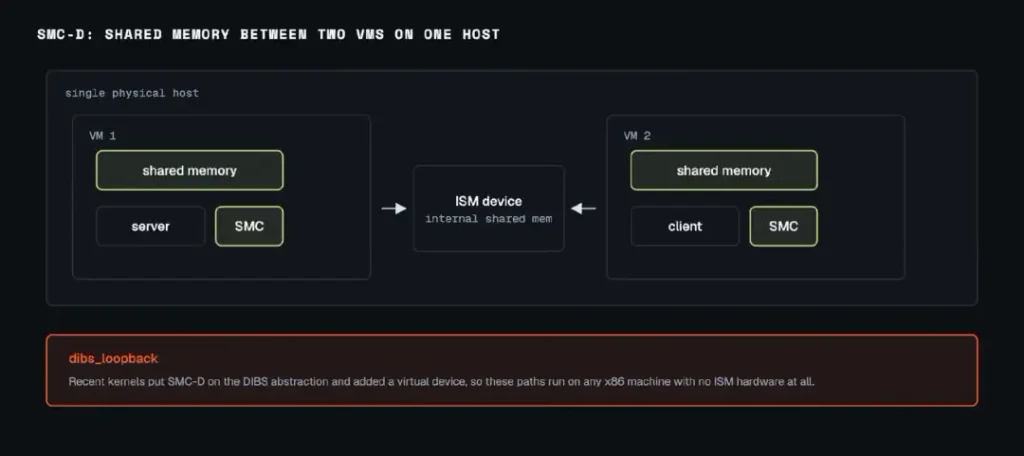
The affected code passed the resulting offset into the DIBS loopback layer, where the unchecked memcpy() operation could write beyond a 16 KB DMB allocation.
The proof-of-concept was notable because the resulting primitive was severely limited. Rather than granting a conventional arbitrary write, the researchers obtained a predictable 16-byte zero write at a partially controlled, 16 KB-aligned offset.
Despite this restriction, they demonstrated that the primitive could still affect Linux kernel credential objects. By grooming memory so that the zero write overlapped identity-related fields in a process’s cred structure, including the effective UID, the exploit could cause the kernel to treat the process as root.
The local exploitation scenario requires CAP_NET_ADMIN. According to the research, this capability is necessary to initialize the relevant SMC-D setup and to intercept and alter loopback CLC traffic through an nftables NFQUEUE rule.
This limits exposure compared with a fully unprivileged local flaw, but CAP_NET_ADMIN is often available to containerized workloads, network services, and privileged application components.
XBOW reported a working exploit on Ubuntu 24.04 running Linux 7.1.0-rc6 with kernel mitigations disabled.
In testing across 100 separate boots, the proof-of-concept gained root access in 22 cases, illustrating that even a constrained corruption primitive can produce a viable privilege-escalation path under favorable heap conditions.
Kernel maintainers have resolved the issue by adding validation that rejects requests where offset + size exceeds the registered DMB length, returning -EINVAL rather than performing the memory copy.
Administrators should install a vendor kernel update containing the fix; the CVE record identifies Linux versions 6.12.97, 6.18.40, and 7.1.5 or later as unaffected maintenance releases.
Join 16,000+ SOC teams using ANY.RUN to streamline threat investigations and reduce manual effort. Explore for your team

