
A newly registered threat actor is hawking what they claim is a fully functional macOS local privilege escalation (LPE) zero-day on a popular underground marketplace.
The advertisement, posted only eight hours ago, states that the exploit spans macOS 13.0 through 15.5—and even Apple’s un-released “macOS 26” beta—allowing any unprivileged user to gain root rights in one shot.
Priced at $130,000, the offer underscores the thriving demand for macOS intrusion vectors among cyber-criminal syndicates and advanced persistent threat groups.
The forum post—filed under the board’s “Software ➝ malware, exploits, bundles, crypts” category—lists the following specifications:
- Coverage: macOS 13.0, 13.1, …, 15.5, plus macOS 26 beta
- Exploit class: “Logical” (meaning no memory-corruption or sandbox escape is required)
- Claimed reliability: “100%”
- Price: $130,000 (forum-escrow acceptable)
Although the seller, alias skart7, asserts complete reliability, no technical proof-of-concept, screenshots, or third-party validation accompanies the post.
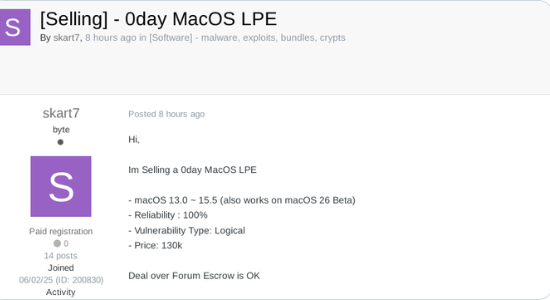
The actor’s profile shows just 14 forum messages and no prior reputation feedback—significant red flags that raise the probability of exaggeration, a resell of patched bugs, or an outright scam.
Potential Impact on macOS Ecosystem
If genuine, a logical LPE affecting four major versions could prove devastating. Root-level access allows:
- Bypassing Transparency, Consent, and Control (TCC) prompts, thereby harvesting keychains or screen-recording without user approval.
- Implanting persistent launch daemons or system extensions that survive reboots and macOS updates.
- Deactivating Gatekeeper and System Integrity Protection (SIP) to side-load malicious binaries invisibly.
Enterprise fleets relying on mobile-device-management (MDM) to lock down user permissions would face a dangerous blind spot because an LPE nullifies per-user sandbox boundaries.
In espionage scenarios, the exploit could deliver co-opted notarized apps that silently escalate and exfiltrate sensitive corporate documents.
Cyber-crime crews could also weaponize the bug for high-value ransomware operations, where root access accelerates file encryption and obliterates local backups.
Verifying a Zero-Day in Dark Markets
According to Report, Apple has yet to issue any advisories for an LPE spanning macOS Ventura through the current Sequoia developer builds.
Underground zero-day exchanges often run on trust-based metrics: seniority, escrow terms, and vetted intermediate testers. That vetting step is missing here. Red-team operators evaluating the listing should:
- Demand a partial video demo or hash-locked proof-of-concept that triggers on a specified macOS release.
- Ask for a deterministic indicator (e.g., unique kernel panic code path) that confirms exploitation without disclosing the full payload.
- Leverage a reputable escrow agent to hold funds until a mutually agreed proof window passes.
Failure to implement these controls could lead to a $130,000 loss. Furthermore, the conspicuous inclusion of “macOS 26 beta” may be a marketing stunt; Apple has not publicly branded its next-generation OS as “26,” suggesting the seller is either conflating internal build numbers or fabricating coverage claims outright.
Apple has yet to issue any advisories for an LPE spanning macOS Ventura through the current Sequoia developer builds.
Security teams should nonetheless strengthen endpoint monitoring for anomalous privilege-escalation attempts and review TCC logs for unexpected root acquisitions.
Until the exploit’s legitimacy is either proven or debunked, organizations with mission-critical macOS assets remain on high alert.
Find this Story Interesting! Follow us on LinkedIn and X to Get More Instant Updates.

 zero-day on a popular underground marketplace.)